Companies Are Investing in AI and Cutting Staff. I Worry About What Comes Next
As AI investment and layoffs proceed together, I think about income and power after jobs disappear, and why the aristocrats and megacorporations of Denma, Dune, and Stellaris no longer feel so distant.
Companies investing enormous sums in AI are also cutting staff. Developing new technology and expanding a business might seem to require more people, yet investment announcements arrive alongside layoff announcements. As I read about a company's promising future, I find myself wondering how many of its current employees will be part of it.
From management's perspective, the two decisions can fit together. Reduce recurring spending on people and invest in technology and equipment that let fewer people do more work. Whether that calculation actually works is a separate question, but I can understand what companies hope to achieve.
That is why I find it difficult to respond to these stories with anger or cynicism alone. Following where the money goes leads to a question larger than the loss of a few jobs. If production keeps requiring fewer people, who will retain the money and power in that society?

An AI-generated illustration imagining a company where production and computing continue after employees leave.
The company that never rests: a management dream
People need to eat and rest. They commute, sleep, and seek treatment when they are ill. They negotiate salaries, ask for benefits, and, when necessary, organize unions to challenge company decisions. These are ordinary parts of a worker's life, but they are also conditions that management must continually account for when controlling costs and output.
What if many of those conditions could be removed? Imagine machines and software taking turns to handle work around the clock, without waiting for employees to finish meals, sleep, take vacations, or negotiate wages. That is the image I have in mind when I think of an "infinite loop of steel." Production continues, and negotiation with people is kept to a minimum. How attractive would that prospect be to executives and boards?
Of course, today's AI and robots cannot work without limits. They need electricity and semiconductors. They break down and make mistakes, and people must maintain them and judge their results. Automation can also cost more than employing people. Still, if replacing human tasks with machines can produce more profit, companies have ample reason to keep attempting that transition.
What concerns me here is the basis on which workers can negotiate with a company. Workers bargain over wages and working conditions because a company needs their labor. If that need itself diminishes, how much room will remain for their demands?
A thriving company does not guarantee that my job will remain
This change is not confined to companies developing AI models. Companies that put models into services, supply enterprise solutions, or operate clouds and platforms are also making decisions to reduce or reassign staff.
In 2025, Andy Jassy of Amazon, which operates AWS, told employees:
We will need fewer people doing some of the jobs that are being done today, and more people doing other types of jobs.
This sentence comes from Jassy's June 2025 message to employees about generative AI. The Korean version of this essay translates the quotation; the original English is reproduced here. In the same message, he said he expected efficiency gains from AI to reduce Amazon's total corporate workforce over the next few years. Amazon later announced in an organizational update that it would cut about 14,000 corporate roles while continuing to hire in some areas.
In a July 2025 message to employees, Microsoft's Satya Nadella also described a situation in which the company was growing and increasing capital expenditure while carrying out layoffs. He also said overall headcount was relatively unchanged. Even if a company's total size stays the same, some employees can leave while people with different expertise join at high salaries.
In April 2026, Meta's plan to cut about 8,000 jobs was reported. In its quarterly filing for the period ended August 2026, Oracle included the adoption of AI in some operations among the efficiency measures in its restructuring plan. It also disclosed that it had added about $700 million to the plan after the end of August.
We cannot treat all these layoffs as the direct replacement of people by AI. Reorganization, changes in business priorities, and the need to fund investment also play a part. Even so, these announcements make it harder to expect that a company's success will keep its employees' jobs secure. A business can grow while building an organization that needs fewer of its current workers.
Rehiring a few people does not bring back all the jobs
Consider a case in which some workers are needed again after mass layoffs. The fact that a company starts looking for people again does not, by itself, establish that automation failed or that employment will return to its previous level. Keeping necessary work going while reducing total costs may matter more to the company.
Here is a simple hypothetical example, not a set of figures from an actual company. Suppose the annual payroll for 100 employees is represented by 100. What if the company lets them go, rehires 10 people, and sets the total payroll for those 10 at 30?
Each rehired employee could receive three times the previous workforce's average pay. Yet the company's total payroll would fall by 70%. Paying a small number of people highly and eliminating a large number of jobs can happen at the same time.
Actual profitability would, of course, depend on severance costs, AI service fees, capital investment, maintenance, and losses caused by lower quality. A 70% reduction in payroll does not mean profits rise by the same amount. But this example shows why news of a few highly paid hires does not resolve employment insecurity for the majority.
Even if the company successfully secures the ten people it needs at high salaries, the livelihoods of the ninety who do not return remain unresolved.
Where do lower payroll costs and greater investment lead?
It is natural to feel angry about layoffs. Alongside that anger, though, I think we need to look at what companies buy next. Whether they spend on hiring more people or on adding data centers, semiconductors, robots, and automated equipment can shape future employment.
The same Oracle quarterly filing reports that cash spending on capital expenditure rose from $8.5 billion in the year-earlier quarter to $28.5 billion, driven by data center expansion. The company pursuing layoffs has not stopped investing. While changing its staffing, it is spending more to secure production capacity.
Tesla's Gigafactories and Terafab, a project pursued by Tesla, SpaceX, and xAI, also make me think about this direction. The Terafab project website describes a plan to bring logic chips, memory, and advanced packaging together and produce AI chips at large scale for use on Earth and in space.
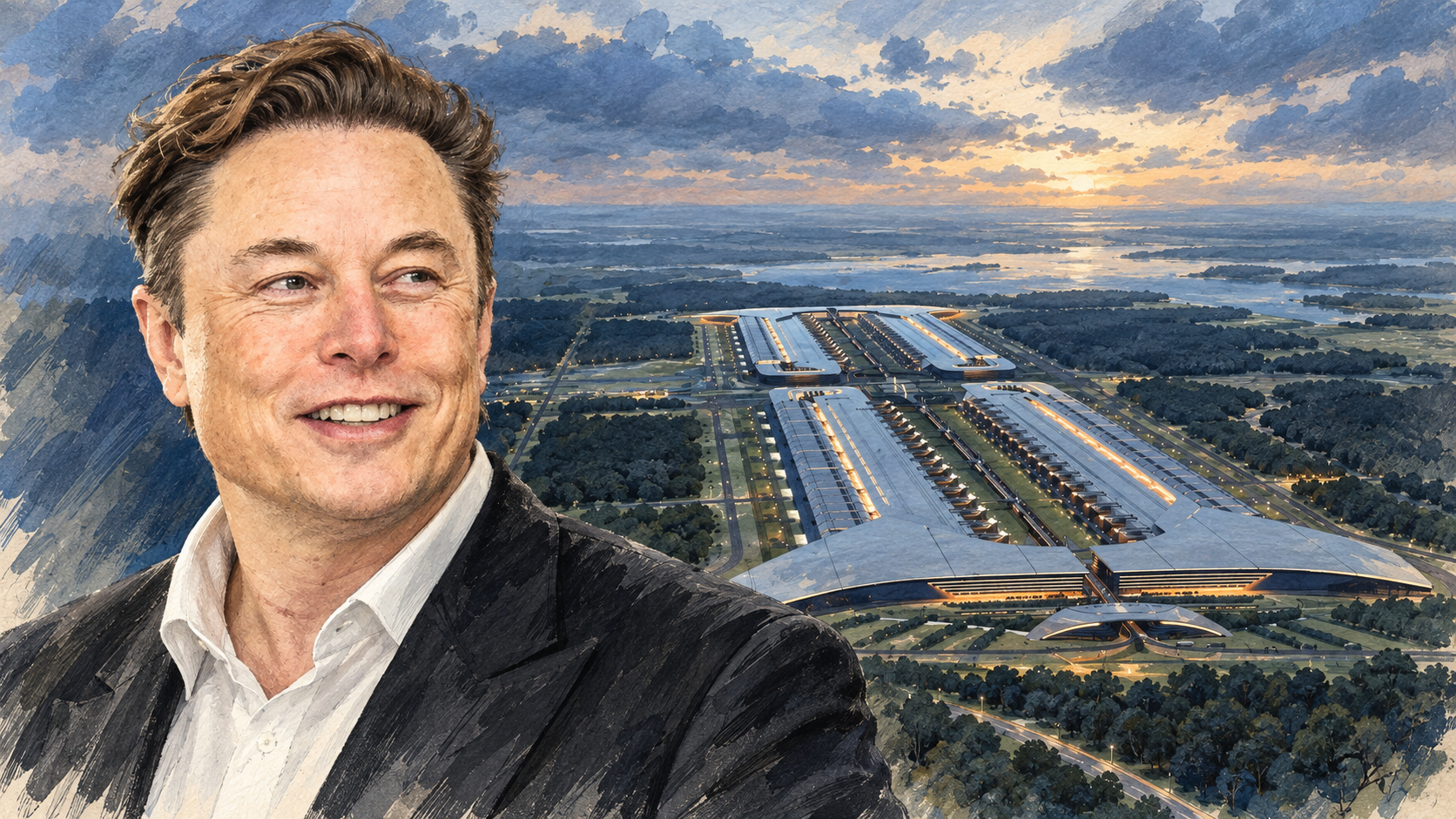
An AI illustration combining and transforming a photograph of Musk and a planned aerial view of Terafab into a painting. Portrait: Justin R. Pacheco / U.S. Air Force, public domain. Facility reference: Terafab project website.
.jpg)
This does not mean that today's Gigafactories have no people. Tesla's manufacturing page shows production workers and engineers working alongside robots. Nor does Terafab's announced plan establish that fully unmanned production has been achieved. What I see is a direction: use more machinery and software, and increase the number of people required to expand production by as little as possible.
If that continues, the rate at which companies grow and the rate at which jobs increase may diverge further. More goods and services may be produced while a smaller share of the proceeds is paid out as wages. As more profit goes to those who own production equipment and software, what will people who own neither live on?
How much choice would a life on basic income offer?
What kind of life should humanity pursue then? Perhaps we could work less, enjoy entertainment, or spend our time on philosophy and art. If we no longer had to worry about making a living, playing games, reading books, and making things could be valuable ways to live. Lifelong employment by a company is probably not the only basis for a meaningful life.
The future that makes me uneasy is one in which people combine basic income with small cash rewards from games and can barely maintain a basic standard of living. What if they can survive but cannot afford to move home or start something new, and have little prospect of owning productive assets or participating in important social decisions? Would the freedom to choose entertainment give them enough control over their lives?
The amount of basic income and its funding would matter, but so would the rights under which people receive it. A society that guarantees income through a system its citizens have collectively established would give individuals different powers from one that provides living allowances on terms set by a giant company or a few wealthy asset owners.
These thoughts bring to mind Yang Young-soon's Denma. It depicts a world where space aristocrats own planets and treat the people living there however their families' interests require. Human lives count for less than aristocratic interests. Remembering that world now feels different from reading it as a space fantasy setting.
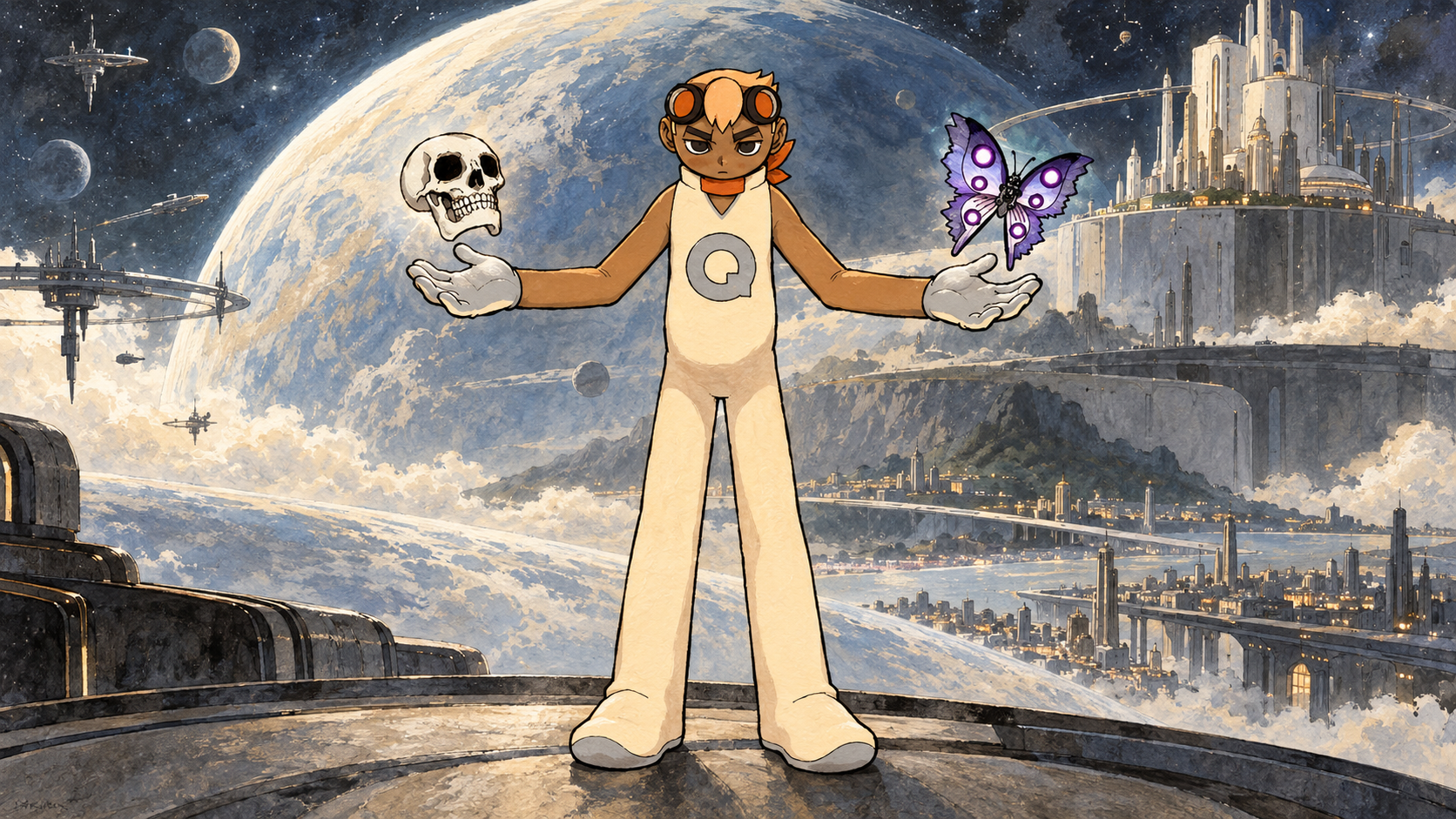
An AI illustration based on the protagonist in a promotional image for Denma. The planets and city background were newly composed. Original work: Yang Young-soon / Naver Webtoon.
The idea of an aristocrat owning a planet still sounds far-fetched. But describe it as a tiny minority controlling the housing, energy, communications, and production facilities that people need to live, and it does not feel quite so remote. That is the techno-aristocracy I worry about: a future in which a few people who control technology also determine the living conditions of the many.
Why Dune's aristocracy no longer seems merely absurd
Dune has an emperor of the universe, dukes who govern planets, and noble houses. The spice of Arrakis is deeply connected to human abilities and the workings of space civilization, while struggles for power lead to a vast holy war, a jihad. Taken individually, these elements sound far removed from modern society.

An AI illustration transforming a House Atreides still from Dune (2021) into a painting. Reference image: film still published by Vanity Fair.

Of course, the main story of Dune takes place in a world where thinking machines are prohibited. It does not directly depict a society making extensive use of AGI. The parallel I see with today's AI industry is a structure in which a few people control the resources and technology needed to sustain civilization, and that control becomes the authority to rule.
Suppose AGI comes to handle a broad range of intellectual tasks and robots take on a substantial share of physical production. If the groups owning those systems also secure energy and transport, they may need to employ far fewer people to keep their businesses running. If space settlements and resource extraction facilities belong to those same groups, I wonder how dependent their residents would become on the owners.
The faster technology develops, the more I worry that the emergence of such a ruling order might ultimately be a matter of time. Technology keeps advancing, but I am unsure whether discussion of how to share the power it creates is keeping pace.
We cannot yet be certain about when AGI will arrive, what it will be capable of, or how quickly space settlement will develop. An aristocratic society is not a predetermined outcome either. Still, technological progress alone gives us little reason to assume that human freedom and bargaining power will grow with it. The same technology could produce very different societies depending on how we arrange ownership, distribution, and political authority.
Who are we inside a company as large as a state?
Move this scenario into space and the problem becomes more immediate. Suppose one company supplies a settlement's oxygen, electricity, housing, communications network, and means of travel to other planets. To its residents, that company would be far more than a business selling a few products.
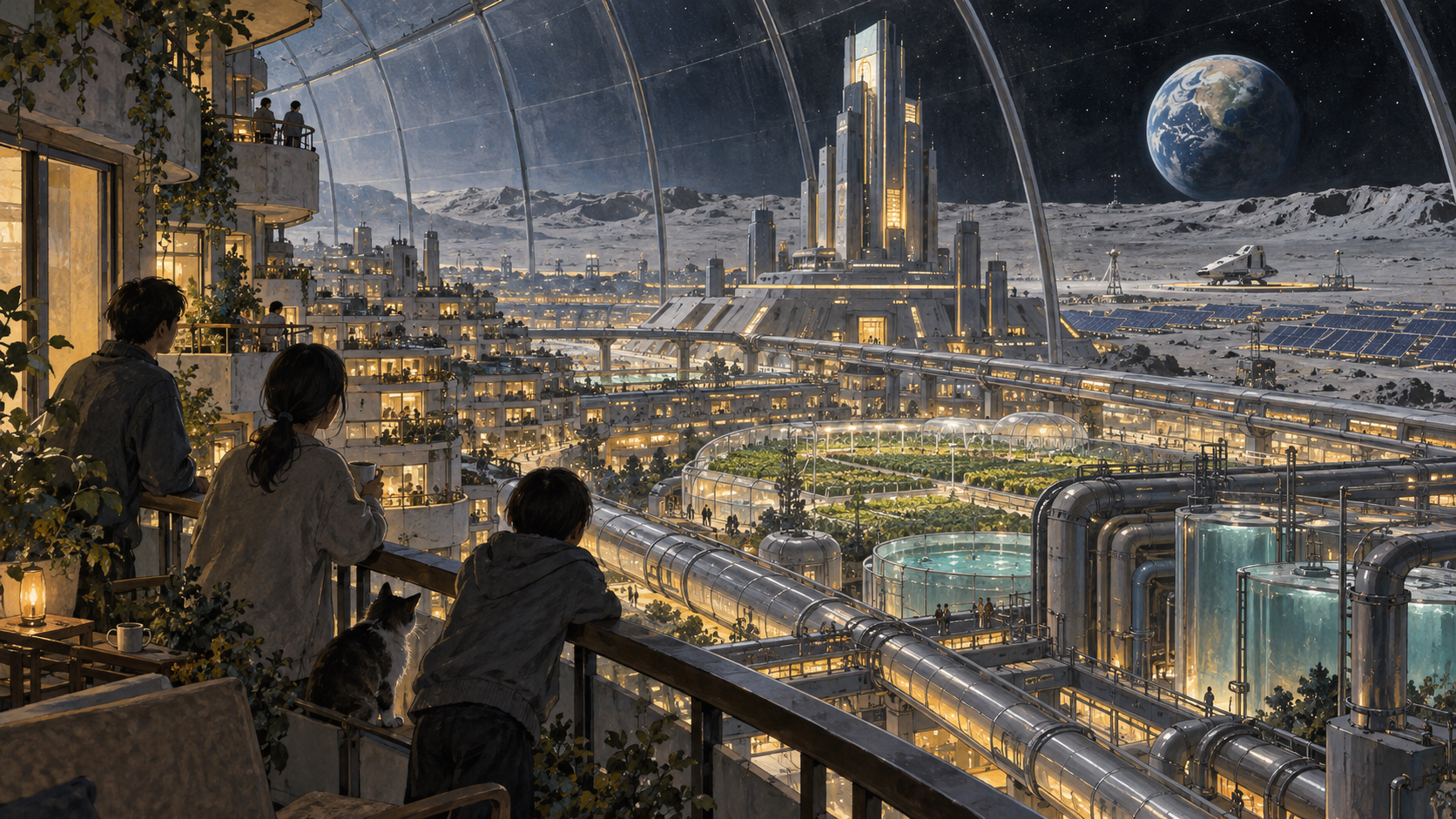
An AI-generated illustration imagining a space city where one company supplies housing, life-support facilities, and transportation.
Even on Earth, losing a job and moving elsewhere is not easy. How meaningful would the freedom to leave be in a place where getting outside the company requires a spacecraft? Could residents participate in making the rules as citizens? Could they reject a company decision and still be guaranteed the basics of life?
It makes me imagine a future like Stellaris: MegaCorp, where companies grow to the scale of states and compete over territory and resources. As the groups that own the facilities needed for production and survival keep one another in check, could they end up in something approaching a war of all against all? I am curious about that outcome, and afraid of it.
That is why I think we cannot keep postponing discussion of a society with far fewer jobs. We need to discuss how to distribute the additional income automation creates, whether people without jobs can retain stable lives and political rights, and how individuals and communities can challenge giant companies' decisions. If we settle space, we should also establish what rights its residents will have.
I do not already have answers to these questions. I cannot simply state the right amount of basic income or how large companies should be allowed to become. But I feel that expecting everyone to keep retraining and finding the next job after AI arrives is not enough preparation.
When companies emerge that produce without resting, I hope people who do not own them will still be able to decide how to live. That is what I ultimately want to understand when I read about AI investment and layoffs. In an age when people can work less, can we become freer than we are today?