When Atlas Enters the Factory, Who Gets the Additional Profit?
Boston Dynamics' Atlas deployment plans raise questions about the economics and ownership of robots. A follow-up to yesterday's essay on AI investment and job cuts, examining the costs and benefits of automation.
Yesterday, I wrote about companies investing in AI while cutting staff. If production keeps requiring fewer people, who will retain the income and power? I worried about a society in which a small group that owns the technology also determines the living conditions of everyone else.
Boston Dynamics' Atlas has made me consider that question in more concrete terms. Yesterday, I looked broadly at the society AI and automation could create. Today, I want to start with a single factory considering whether to introduce robots. How much would it cost, what work could the robots do, and who would receive the additional profit?
It is welcome news when robots take on dangerous and physically demanding work. But people's feelings about that progress will depend greatly on what happens to the people who used to do those jobs: whether they can do less strenuous work while keeping their income, or lose both their jobs and their income.
What Work Is Atlas Coming to the Factory to Do?
At CES in January 2026, Boston Dynamics unveiled the product version of its industrial Atlas robot. The announced destinations for that year's deployments were Hyundai Motor Group's Robotics Metaplant Application Center (RMAC) and Google DeepMind. These were initial deployment plans for research, training, and application development. The Atlas product announcement should not be read as news that a large, fully unmanned factory had already been completed.
Hyundai Motor Group's timeline for introducing Atlas into production processes is longer. It plans to begin deploying Atlas in tasks such as preparing parts in the required sequence in 2028, then expand into component assembly in 2030. Its CES 2026 robotics strategy describes a gradual rollout that validates safety and quality process by process.
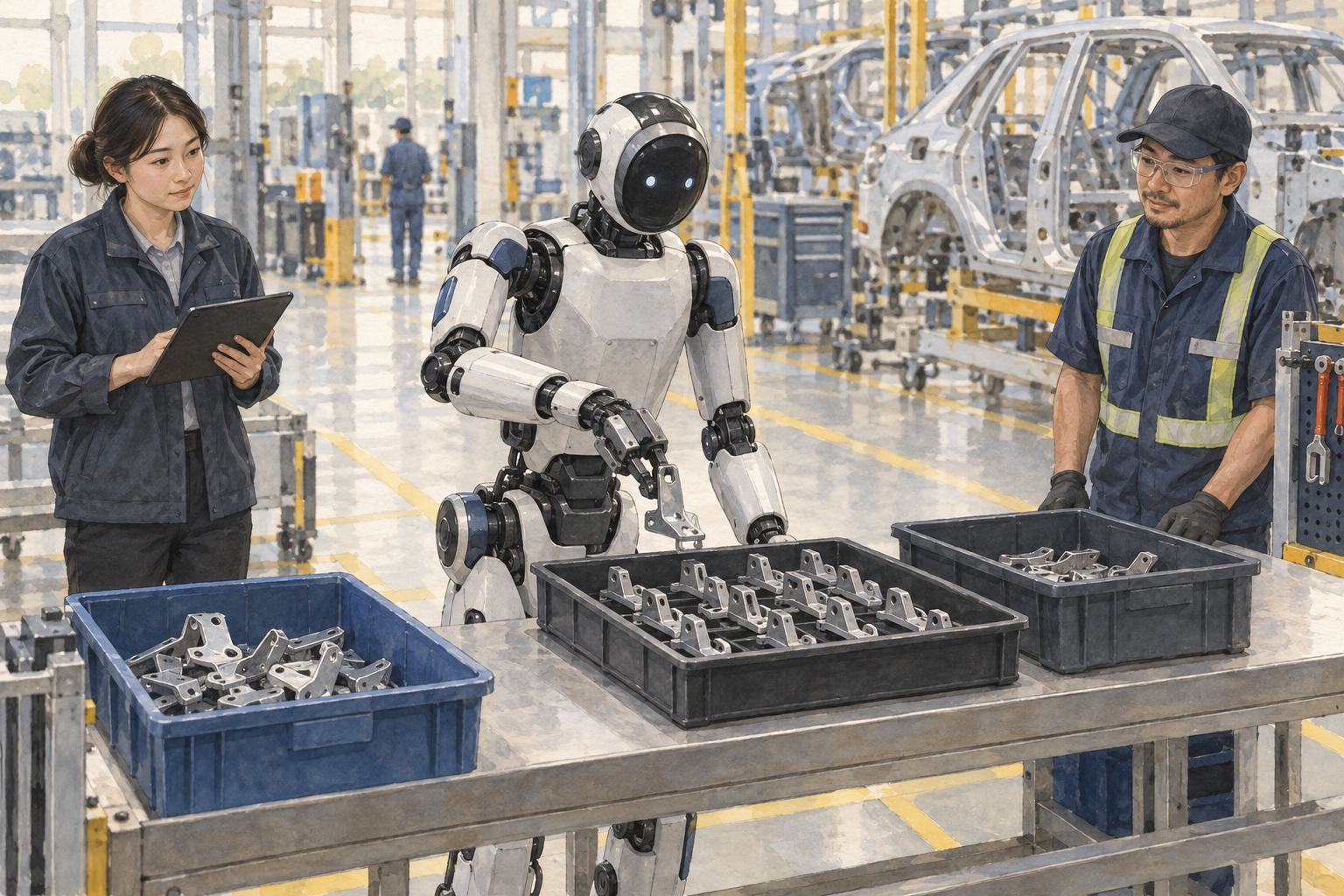
An AI-generated illustration imagining a supervised trial of parts sequencing. It does not reproduce the actual appearance of Atlas or a real deployment site.
What stands out in this timeline is that robots are not being put in charge of the entire factory from the beginning. Their ability to repeat a defined task reliably is checked first, and their responsibilities expand according to the results. The process must verify which parts to pick up, where to put them, whether the robot can cope with changes in their condition, and whether it can move safely alongside people.
I think this focus on specific applications also matters when trying to understand actual changes in employment. A robot does not need to reproduce every human capability to change the number of people needed in a particular process, provided it can work reliably and economically enough there. Conversely, success at one task does not mean all the surrounding work disappears.
The Price of One Robot Is Not Enough to Do the Calculation
Yesterday's essay discussed companies redirecting money from paying people toward technology and equipment. Making that decision in a factory requires a much more specific calculation. Setting the price of a robot beside one employee's annual salary is not enough.
Beyond buying or renting the robot, there are costs for teaching it tasks and connecting it to production management systems. Batteries and components need attention, and people must respond to faults. If the robot works more slowly than expected or defects increase, those losses must be counted too. When a robot's stoppage also halts other processes, even a short interruption can be costly.
In its description of Atlas's industrial design, Boston Dynamics emphasizes autonomous battery replacement, field repairs, and connections to existing workflow systems. Keeping a robot working over time requires an operating and maintenance system alongside its ability to move.
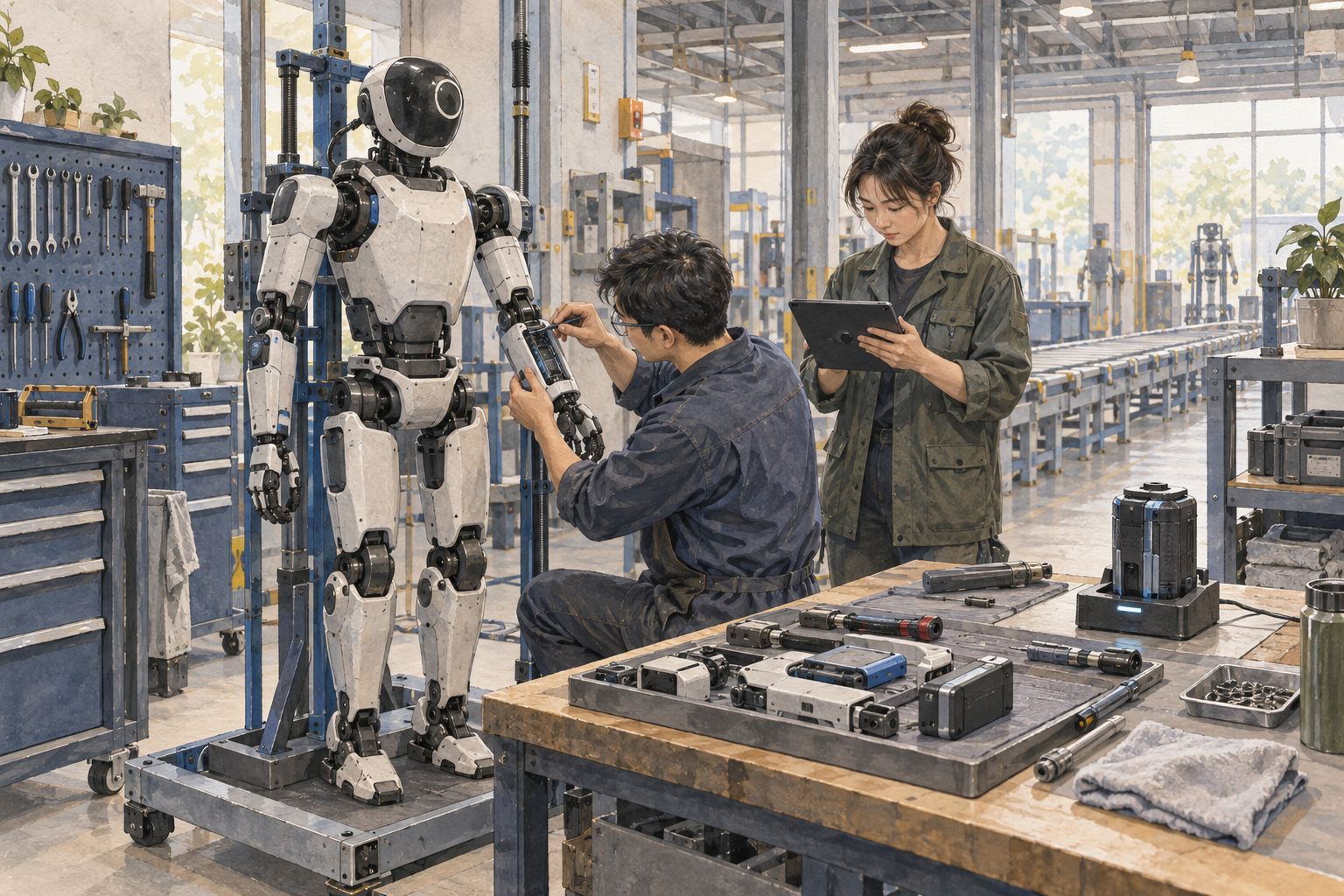
An AI-generated illustration showing the maintenance staff, components, and batteries needed to operate a robot.
The comparison should consider the total cost of completing the same amount of work at the same quality. Human work requires safety equipment, training, rest, and shift arrangements. Robot work requires supervision and maintenance. Leaving out conditions needed on either side makes it difficult to judge the advantages of automation.
Of course, the benefits do not come only from lower labor costs. Reducing hazardous work, maintaining consistent quality, or accepting orders that a shortage of people previously made impossible can also justify adoption. Robots do not have to earn their economic value through layoffs. We first need to ask what problem a company is trying to solve by introducing them.
The public information I have reviewed is not enough to calculate how much a single Atlas would earn for a particular factory. Contract prices, actual operating rates, maintenance records, and quality data would also be needed. Still, I can understand a company's decision to expand adoption first in the processes where the calculation becomes favorable.
What One Robot Learns Can Be Applied to Many
One explanation in the Atlas announcement particularly caught my attention.
Once a single Atlas robot learns a new task, that task can immediately be replicated across the entire fleet of robots.
This sentence comes from Boston Dynamics' product announcement of January 5, 2026. It describes a capability presented by the company. It does not mean the task can be applied to every different factory without validation.
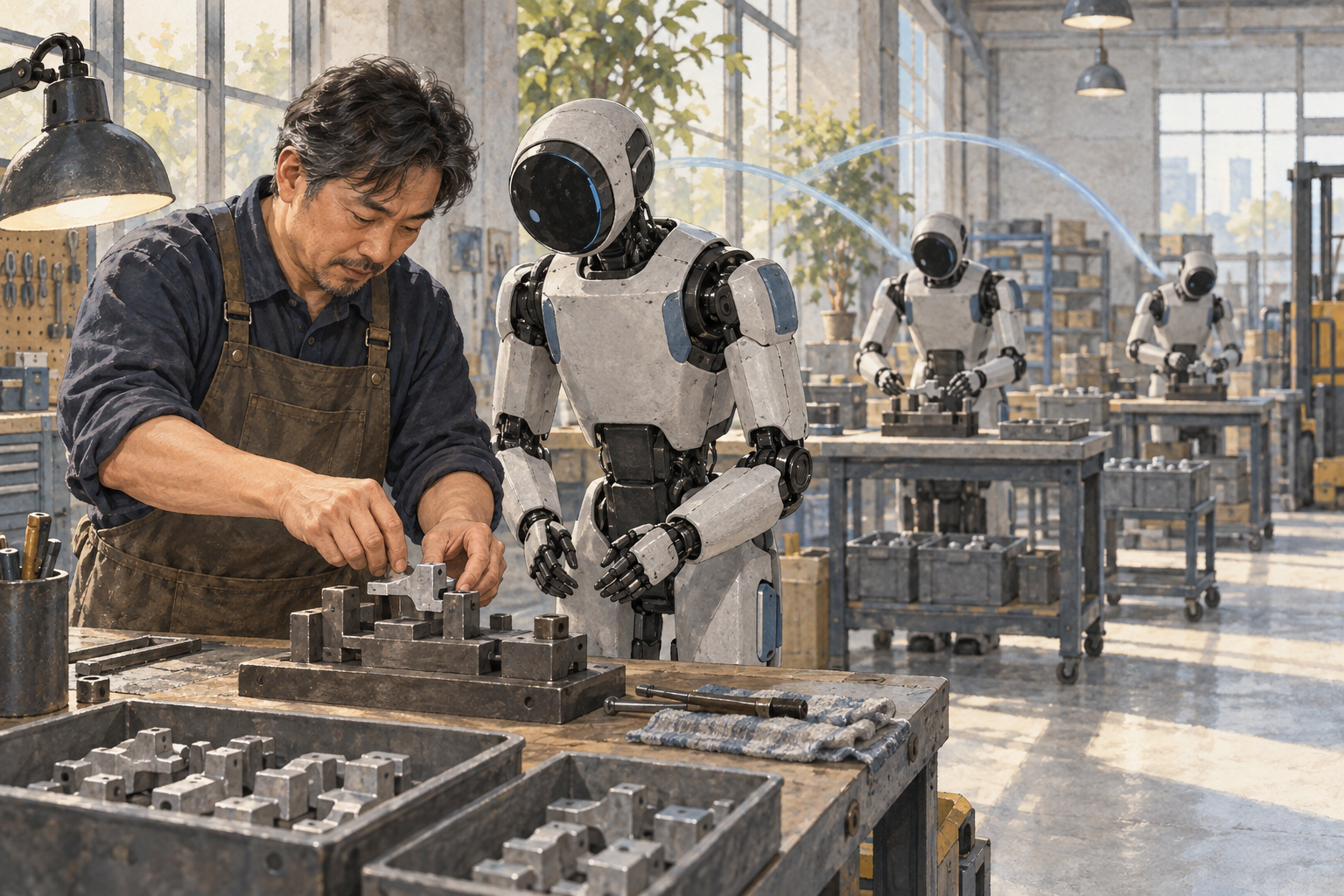
An AI-generated illustration imagining how practical knowledge from the factory floor can be applied to multiple robots.
Learning a task costs money, but applying that learning to multiple robots allows the initial expense to be spread over more output. That is attractive to a company running similar processes at multiple sites. Each site's tools, layout, and safety conditions still need checking, but it points toward less need to repeat the same learning from scratch.
This brings me back to yesterday's question of ownership. Suppose workers' accumulated knowledge of techniques and exceptional situations is used to improve robots. If that raises productivity at several factories, what compensation will the people who provided that knowledge receive? The outcome will differ depending on whether they are paid only for their time as trainers, are guaranteed employment in changed roles, or also share in the gains from improved productivity.
We also need to recognize that the companies developing and deploying robots take investment risks. Spending money on research does not guarantee success, and a failed deployment can bring losses. It should be possible to acknowledge that contribution while discussing how to account for the value created by workers' knowledge and labor.
When people teach robots to work, compensation is part of the process alongside technical training. When I hear that new roles will be created, I also want to know who will fill them and under what conditions.
Ownership Still Matters to Companies That Rent Robots
Questions of ownership do not arise only between robot manufacturers and workers. Companies using robots may also depend on another company's technology and services.
In the robotics strategy introduced earlier, Hyundai Motor Group outlined plans to expand Robotics-as-a-Service (RaaS), offering robots through subscriptions alongside maintenance and software updates. That announcement alone does not tell us Atlas's specific subscription prices or contract terms.
If this model expands, companies unable to spend large sums on equipment at the outset may find it easier to adopt robots. They may also benefit from not having to assemble an entire team of specialized maintenance staff themselves. Making automation accessible to more companies is a positive possibility.
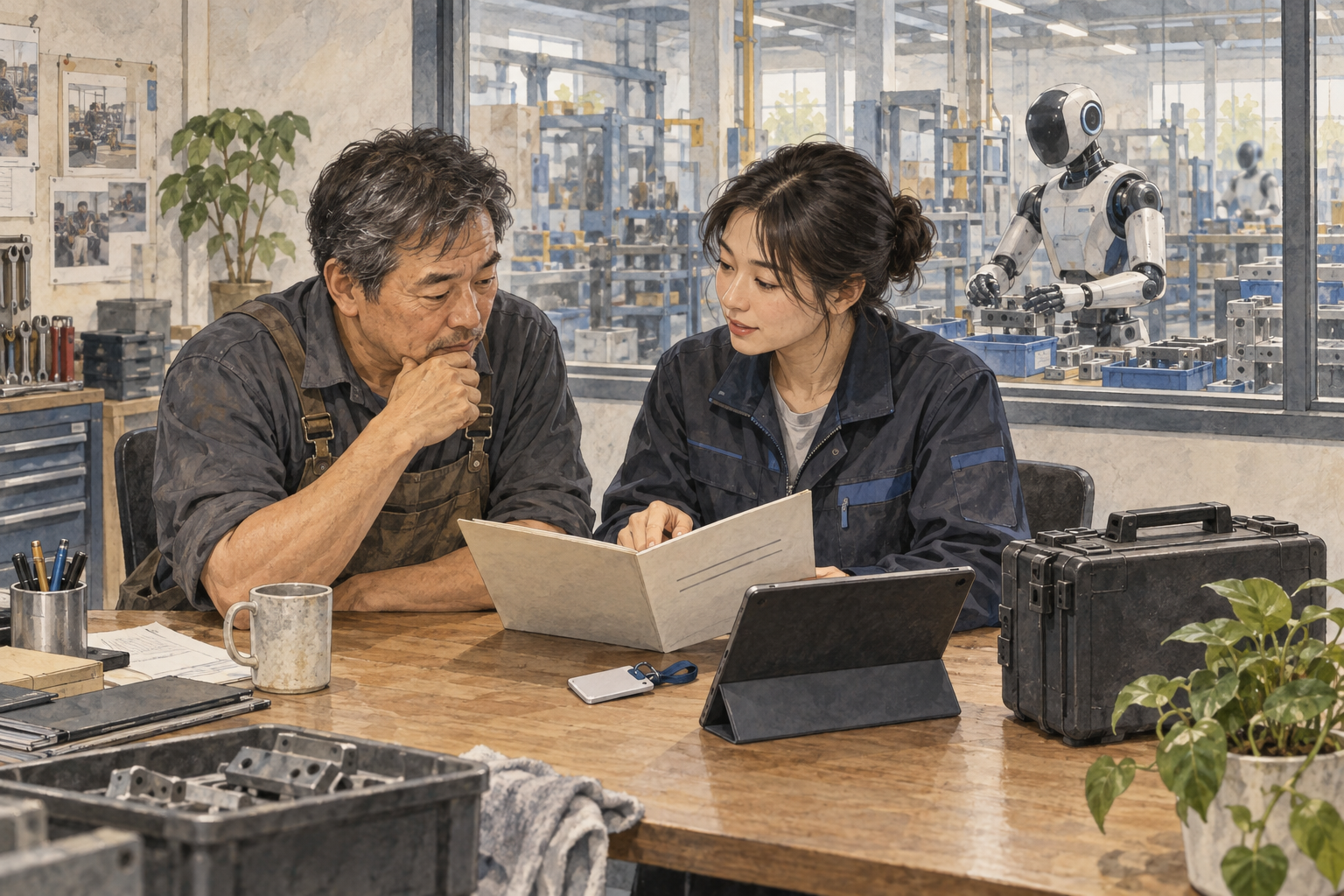
An AI-generated illustration imagining a discussion of robot access and maintenance terms.
At the same time, what happens when fees rise or a contract ends becomes important. Can tasks taught for a particular process be transferred to another product? Who can use the operating data? How much would it cost to change suppliers? These are questions to ask when reviewing a service agreement, not claims that any particular company already imposes such restrictions.
Yesterday, I focused mainly on people who own the means of production and people who do not. If robot services become widespread, several relationships will exist between those groups as well. The robot manufacturer, the AI and software supplier, the company paying to use them for production, and the people working in its factory will hold different rights and powers. Having more robots on a factory floor may not mean its operator can determine every condition of their use.
A Safer Workplace and Fewer Jobs Can Arrive Together
If a robot takes over repeatedly moving heavy components, people may face less risk of injury from that work. I want to welcome that improvement. I do not want to argue that people should keep doing dangerous and exhausting jobs simply to preserve their livelihoods.
The question is what happens after the dangerous work is reduced. A company could shorten the remaining employees' working hours while maintaining their income, or increase production and move them into other roles. It could instead produce the same volume with fewer people and retain the lower labor costs as profit. The technology's performance alone does not determine which choice will be made.
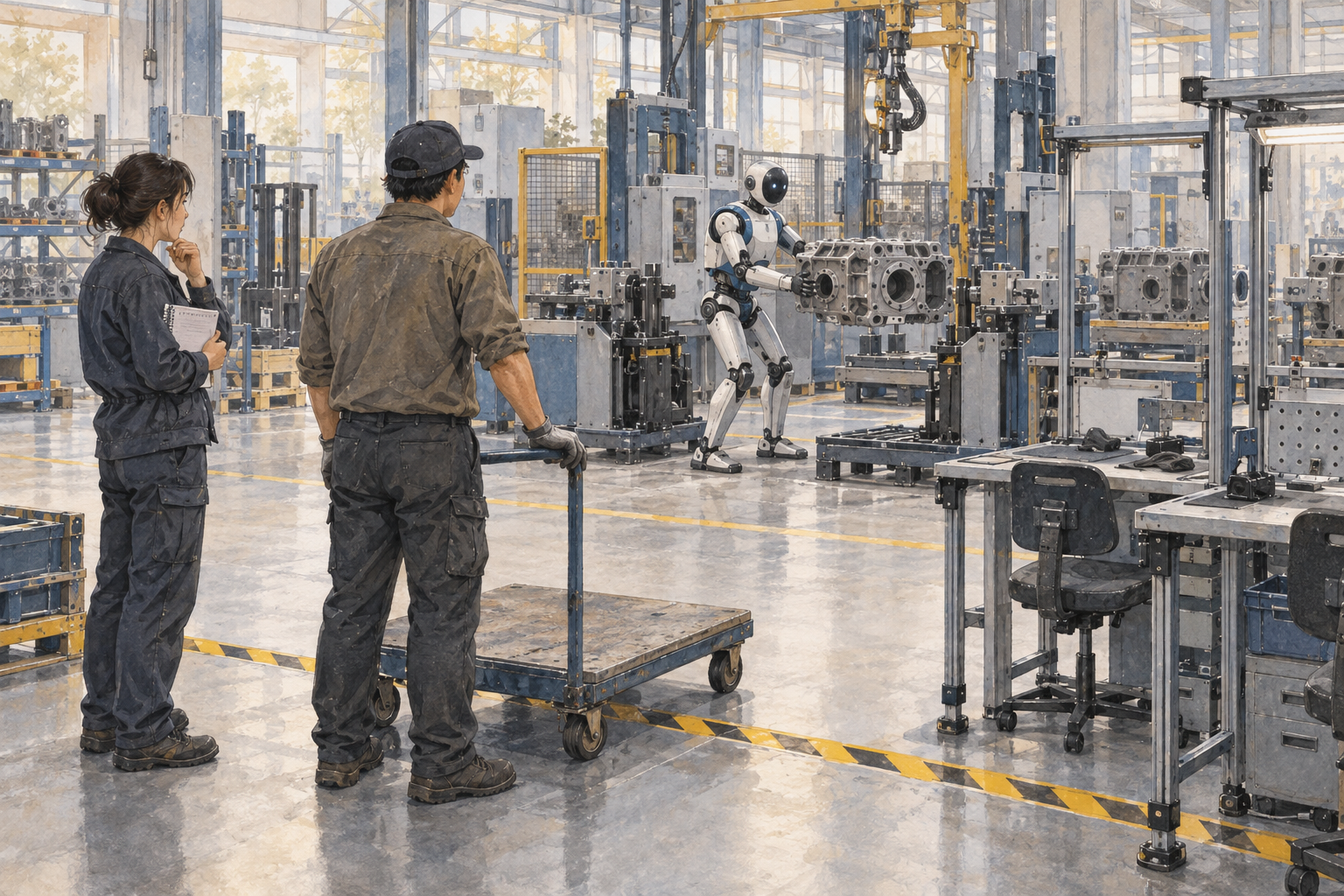
An AI-generated illustration considering both the automation of strenuous work and the changing roles of workers afterward.
Robot supervision and maintenance work may increase. But there is no guarantee that the number of people needed for new tasks will match the number no longer needed for old ones. Whether people changing roles can secure the time and living expenses they need for training is a separate issue. Providing retraining does not, by itself, mean the employment transition is complete.
We should also consider the possibility that automation's benefits reach consumers through lower product prices. How the gains are distributed may vary with competition and changes in demand. Still, necessities becoming a little cheaper and losing one's income may be problems on very different scales. Gains as a consumer do not necessarily compensate for losses as a worker.
That is why I find it difficult to evaluate robot adoption using only output and cost savings. We should also look at how much accidents and physical strain have decreased, how existing employees' incomes and working hours have changed, and who has been left out of the transition.
Workers' Share Should Be Discussed When Robot Adoption Is Decided
Yesterday, my thoughts extended to basic income and a techno-aristocratic society. Reading Atlas's deployment plans today made me realize that this discussion can also begin when a factory decides to invest in equipment.
Before bringing in robots, a company calculates the investment and expected returns. I think it should also be possible to agree on conditions for the people whose work will change at that stage. That means discussing whether training time will be paid, how opportunities to move into other work will be ensured, and how higher productivity will be reflected in pay or working hours.
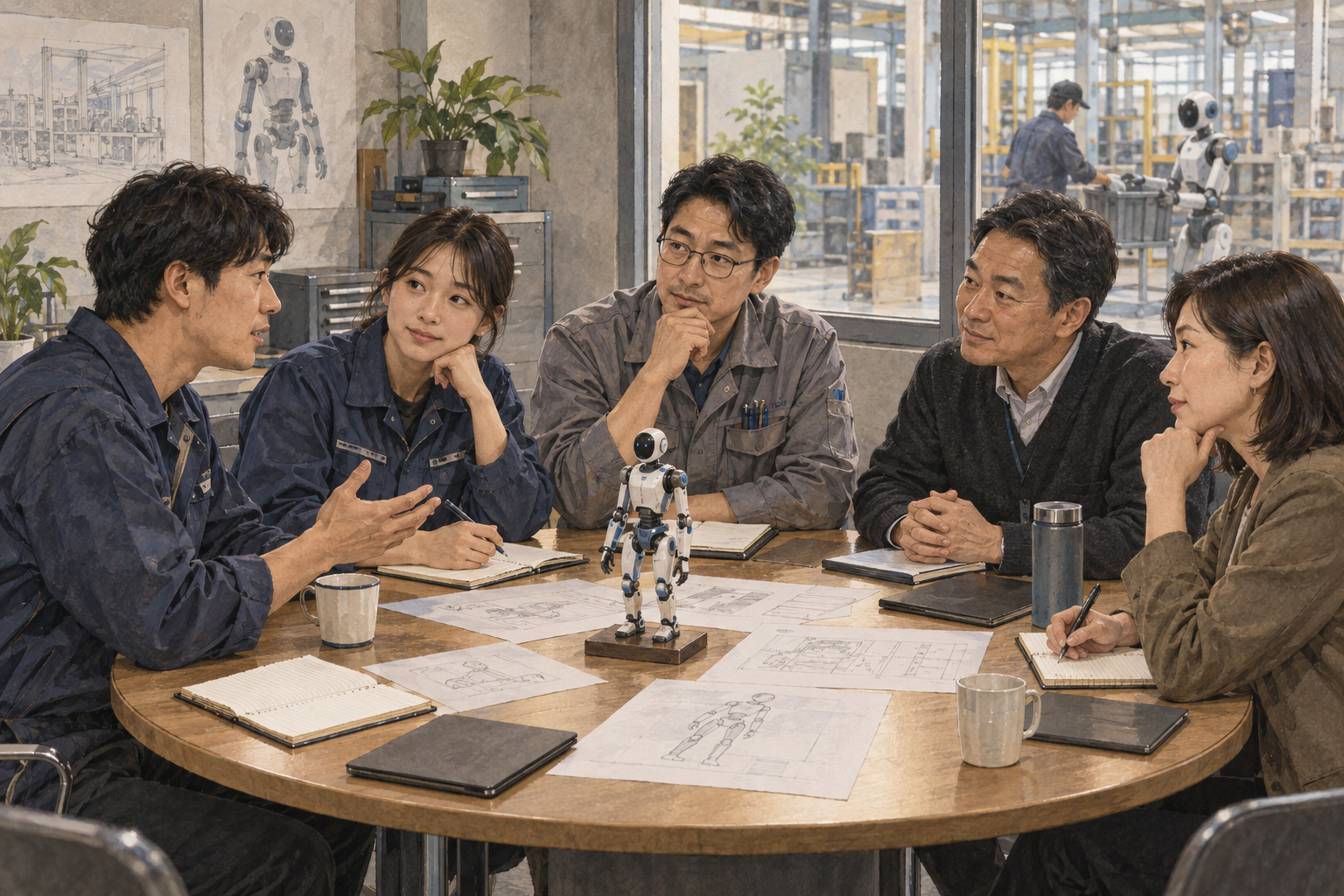
An AI-generated illustration imagining a discussion of training, working conditions, and sharing the gains from robot adoption. It does not depict an actual negotiation or agreement.
Profit sharing and employee ownership could also be options to consider. I do not think applying the same arrangement to every company would solve the problem. Ways of protecting employment and sharing gains may differ with a business's circumstances. But a vague promise to share whatever is left after automation succeeds gives people whose work may disappear little basis for planning their future.
I hope Boston Dynamics' robots become more reliable and reduce tasks that put people at risk of injury. I think it is possible to welcome that progress while also worrying about workers' bargaining power.
When I read future news about Atlas deployments, I want to look beyond the number of robots and the speed of their work. I also want to see how the jobs and incomes of people already working in those factories have changed, and what has gone back to the people who helped the robots learn. To look forward to a future in which people need to work less, we also need news that the lives of those doing less work have actually improved.