When a Robot Wins, Who Gets the Prize Money?
Football searches led me to imagine robot sports: human teams facing robots, ownership of prize money, fans' affection, and robots' personhood and right to decide for themselves.
Today I looked at South Korea's trending searches on Google Trends, sorted by search volume. On the screen updated at 2:48 p.m., football matches appeared in the first, third, and eighth positions: Atlético Madrid against Osasuna, Manchester United against Brighton, and Barcelona against Racing Santander.
That interest in football made me imagine a different kind of competition. What if there were a sports league for robots alone? It could allow speeds and forces that human bodies would struggle to withstand, with players improving as technology advances. If the strongest human team eventually faced the strongest robot team, I think I would want to watch.
Yesterday I thought about who would receive the additional profits generated by Atlas in a factory. The same question followed me into today's thought experiment. If a robot team won, who would get the prize money? Its manufacturer, or the club owner? If we started to think that the robots playing the game deserved a share themselves, what kind of beings would we be accepting them as?
Whose Limits Does the Sport Test?
This thought experiment could begin with a league that allowed doping without limits. How far would we go if we could make bodies faster and stronger? Which human abilities do the sports we watch today actually compare? If restrictions on drugs and body modification disappeared, how would the relative importance of training, judgment, medical technology, and investment change?
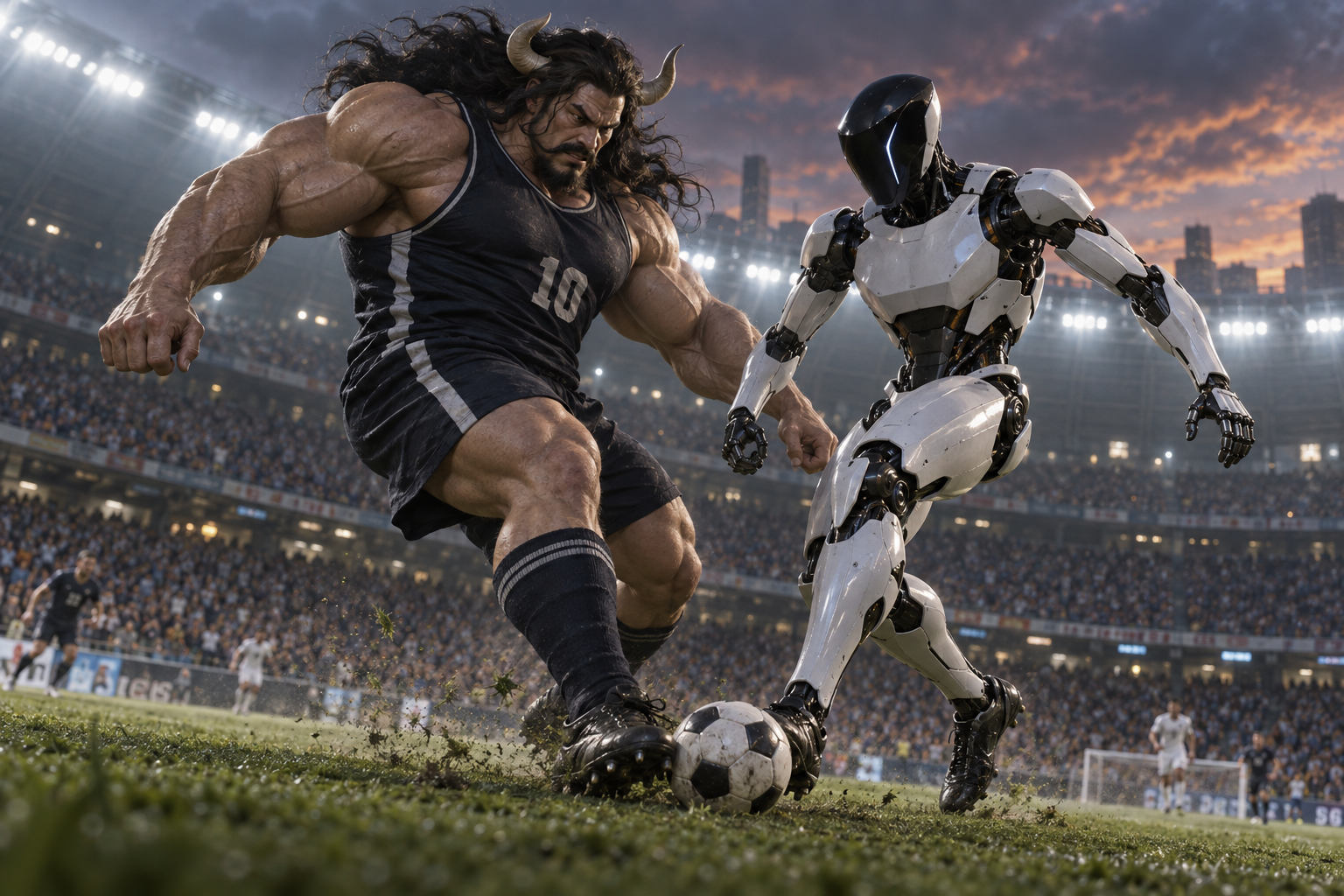
An AI-generated image imagining a football match between an unrealistically enhanced human athlete and a humanoid robot. It does not depict an actual athlete using drugs or a real match.
Enhanced Games does, in fact, promote competition that permits performance enhancement. Its science and medical policy, however, rejects indiscriminate use and emphasizes clinical supervision. Describing it as a competition that allows all doping without limits would be inaccurate. Nor does the organizer's emphasis on medical supervision establish long-term safety.
What makes me think further is the situation in which a choice is made. If refusing a particular intervention could cost an athlete a place in the competition or their livelihood, permission could become pressure to use it. Saying that someone chose freely does not make the competitive and financial pressures behind that choice disappear.
What if robots competed against one another so that human bodies did not have to bear those risks? Motors, batteries, joints, and control software could improve, with competition taking place under conditions different from human physical limits. I can imagine robot sports satisfying some of our desire to see extreme performance.
Even then, removing every restriction would be difficult. We would first have to decide whether a football robot needed two legs or could use wheels or wings. Spectators' and staff members' safety would also matter. Different rules about bodies and capabilities would ultimately produce different sports.
When the Strongest Human Team Meets the Strongest Robot Team
A football match between humans and robots has already been proposed as a research goal.
develop a robot soccer team which beats the human world champion team
That is the goal stated in RoboCup's official explanation. More specifically, its long-term goal is for a fully autonomous humanoid team to beat the human World Cup champions under official FIFA rules by the middle of the 21st century. This is neither a prediction that it will definitely happen by then nor a claim that it has already happened.
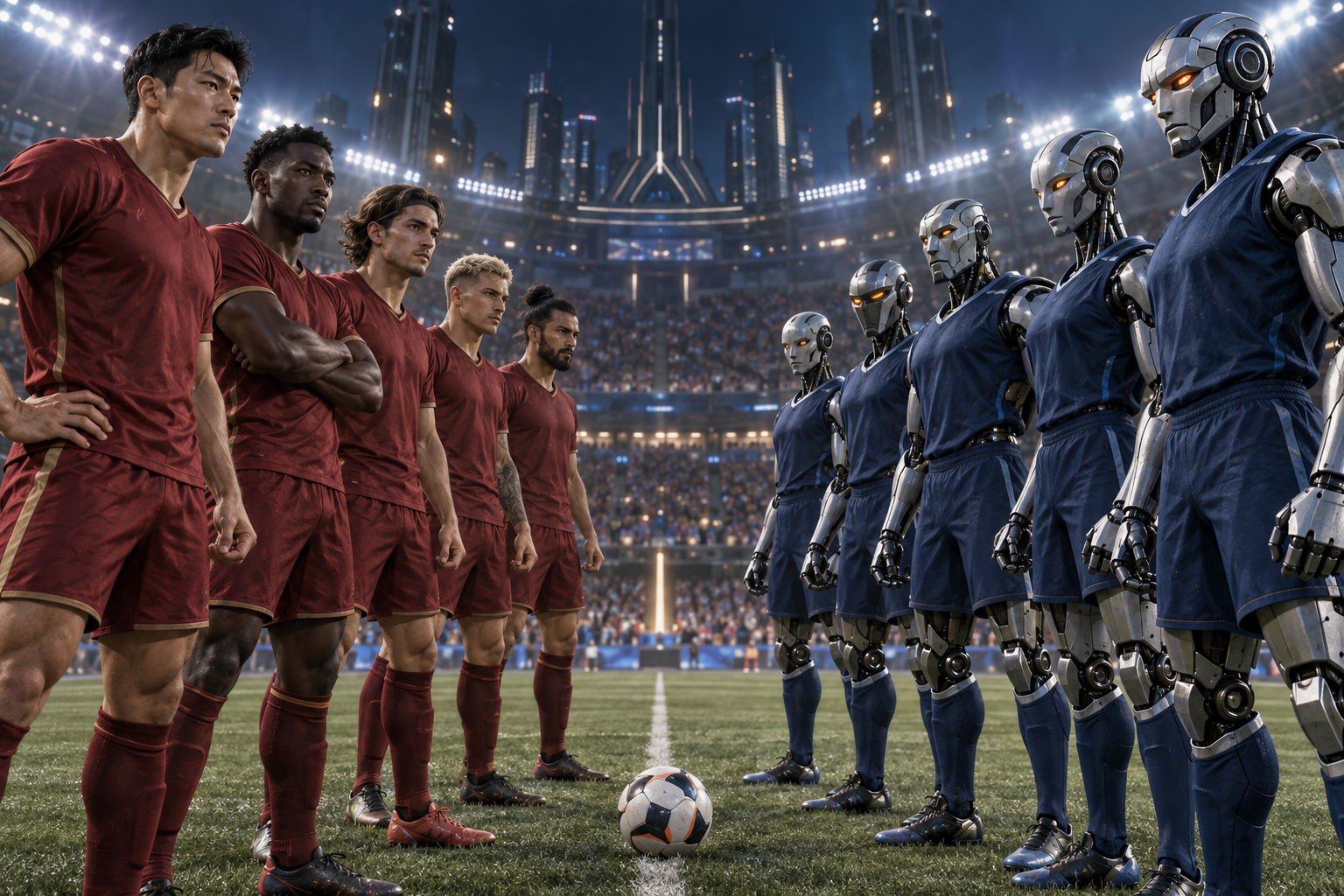
An AI-generated image imagining a match between a human team and a robot team. The human players are fictional.
That goal includes an important condition for the match I am imagining. The meaning of the contest changes depending on whether people control every movement from behind the scenes or robots make their own decisions. We also need to distinguish a game played under the same rules with humanlike bodies from one between machines operating with far fewer performance restrictions.
I think the first match between the strongest human and robot teams could attract considerable attention. But a league meant to last would need to consider what comes after that first game. If one side won overwhelmingly every time, the suspense could fade.
Human leagues, robot leagues, and human-versus-robot matches with special rules might then coexist. We could also imagine humans and robots playing on the same team. Athletes with different bodies sharing a pitch would require new rules for collisions, permitted force, substitutions, and repairs.
The point at which robots become technically capable of beating people may differ from the point at which they play a game people want to watch every week. Lasting robot sports would require entertaining competition as well as powerful machines.
Could People Become Attached to Robot Players?
I do not think people watch sports only to identify the highest level of performance. A favorite player recovering from a mistake, a team winning after years together, or an underdog earning an unexpected victory can also keep us watching.
Could robots develop stories like those? Imagine a player keeping the same name and shirt number across several seasons, showing a distinctive way of playing and a particular role within the team. Spectators who initially came to see a manufacturer's technology might eventually find themselves supporting an individual player.
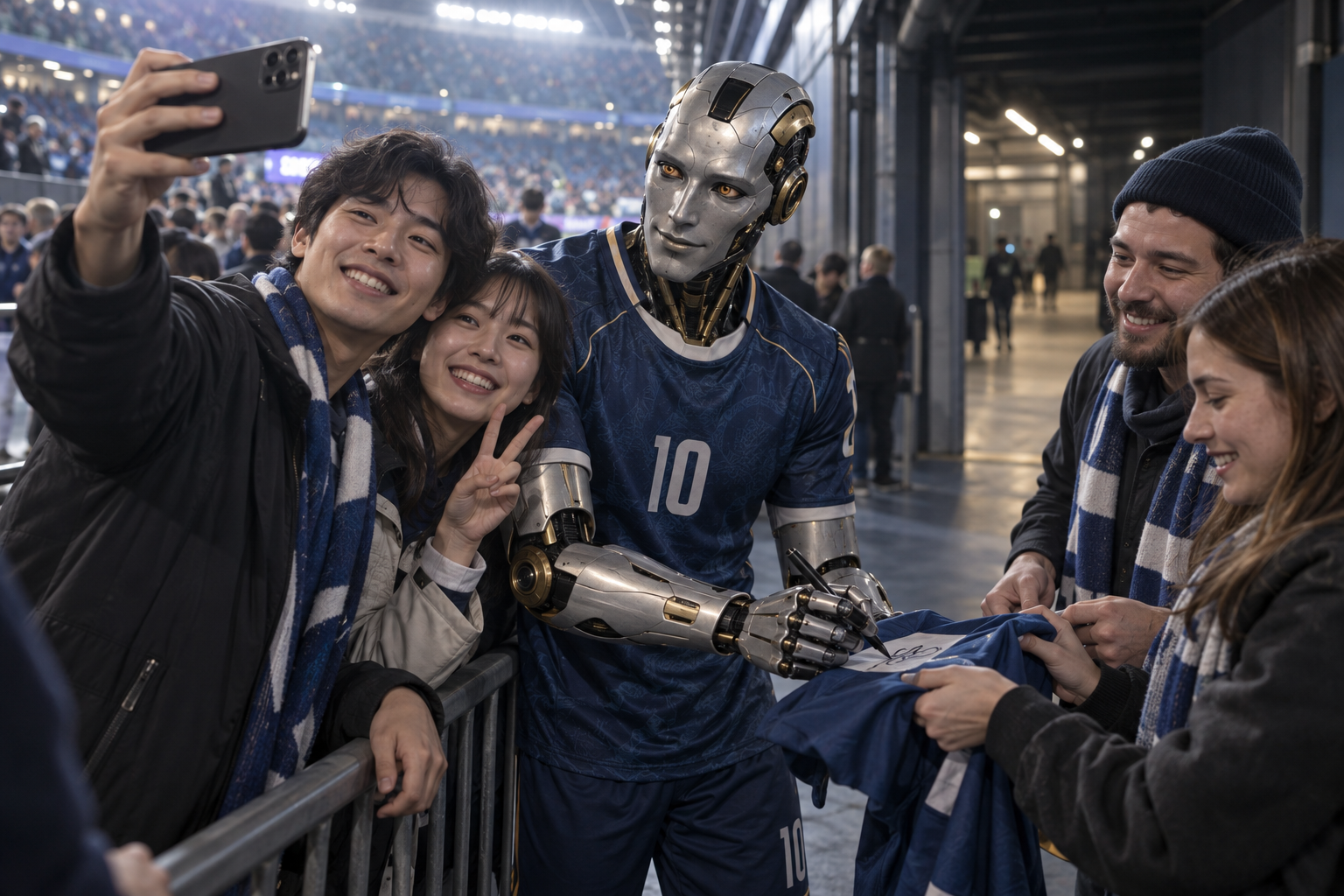
An AI-generated image imagining a future in which a robot player signs autographs and poses for photos with fans.
Repairs and updates might then look different. Fans might still regard a player with replacement legs as the same player, yet feel unfamiliar with one whose learning and memories from the previous season had all been erased. If identical copies of that player appeared on several teams, whom would the fans support?
Fans might stop treating such changes as mere product maintenance. We can imagine them opposing a club's decision to reset a popular player's memory to improve performance. That raises a question about what they would be protecting: a sporting record, or an individual they had grown attached to?
Yet attachment alone would not establish that a robot was conscious or capable of suffering. Skilled play and convincing interviews would not prove it either. The process through which people come to want to respect robots and the process of deciding what rights robots need should each be examined on their own terms.
Who Should Receive the Prize Money?
If we created a league that still treated robots as sporting equipment, the first arrangement to consider would be paying the prize to the participating club or operator. Manufacturers would receive sales revenue and licensing fees, while clubs would cover operating costs and earn competition revenue. Some manufacturers might run their own teams.
But making a robot would not, by itself, settle ownership of every income stream it later generated. Designing a future league would require separate decisions about technology rights, equipment ownership, eligibility to participate, and the distribution of prize money and broadcasting revenue. We would also have to account for cases in which the manufacturer and owner were different parties.
Yesterday's factory discussion asked how profits generated by robots should be divided among people. Sports might introduce another participant into that question: the robot that made decisions and moved during the match. Once spectators began calling it a player, they might ask whether the player deserved a share.
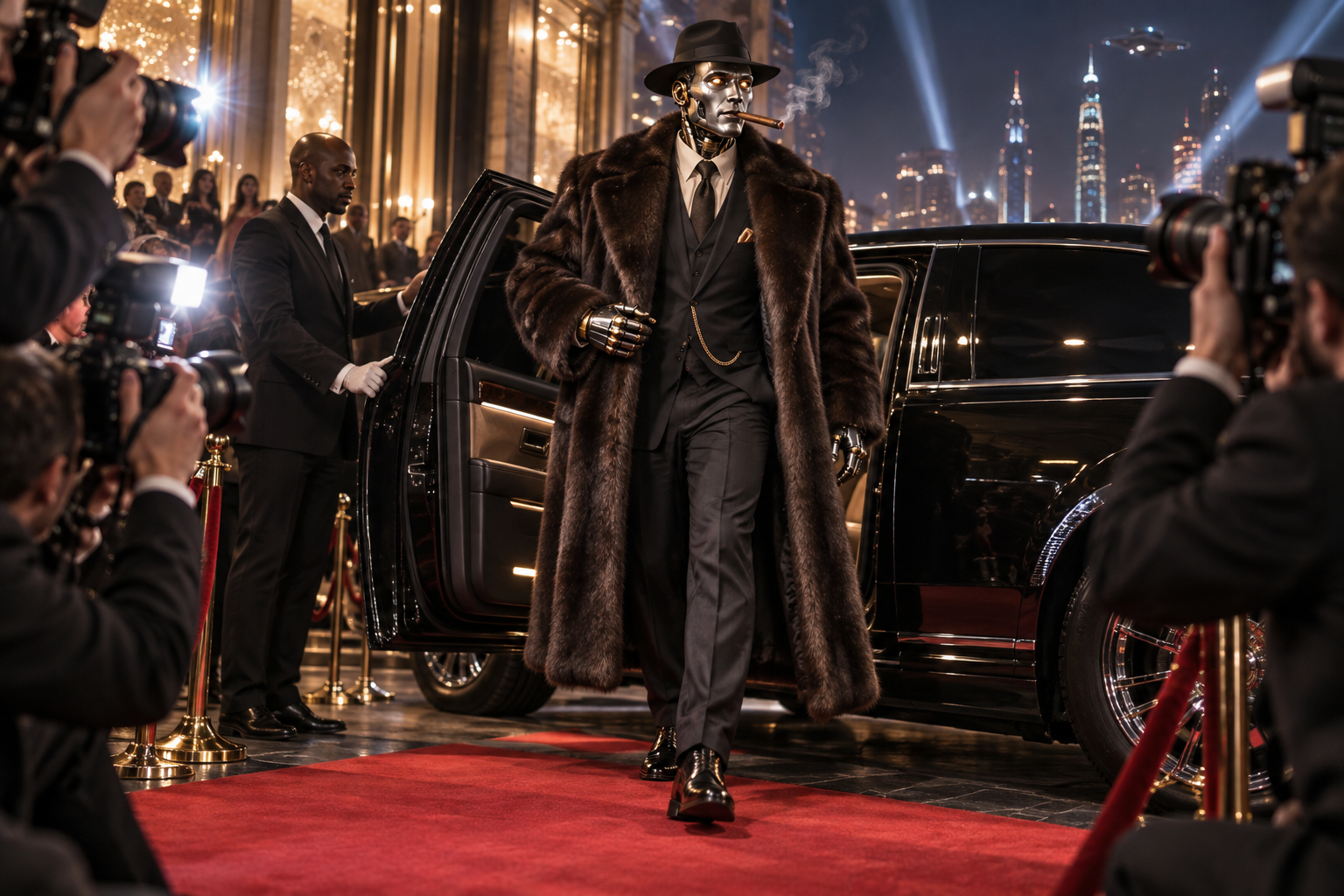
An AI-generated image imagining a robot arriving on a red carpet after gaining prize money and fame.
The discussion would depend on whether the robot remained a tool or could be recognized as a being with interests and a will of its own. Under the latter assumption, we could consider a system that compensated development and operating costs while reserving part of the robot's earnings for the robot itself.
Putting a robot's name on an account would not, however, make it an independent economic actor. If the club owner decided when and where every payment was made, actual decision-making power would remain with the owner. We would need to establish which powers came with the promise of prize money.
Could a Robot Buy Its Own Body with Its Own Money?
Let us take the idea of recognizing robots' income a little further. What if a robot saved its prize money and offered to pay the club that owned it in exchange for independence? Could it sign with another team, choose a maintenance provider, or decide to stop competing?
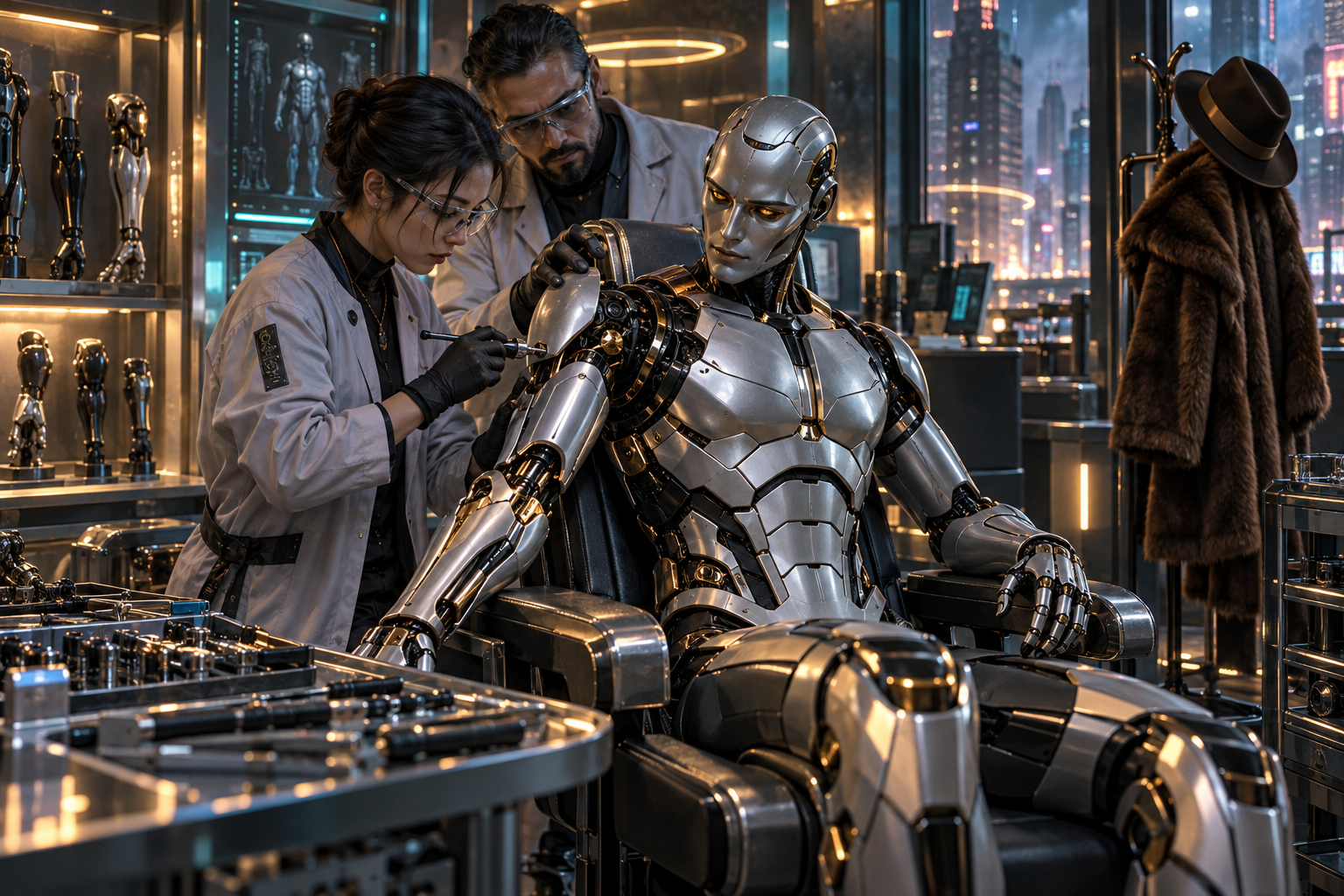
An AI-generated image imagining a robot using its income to replace its body. It does not depict surgery on a human.
Here, permission to participate in economic activity and recognition of personhood emerge as separate questions. We could enable a robot to receive money and pay expenses while making a separate decision about whether it could determine its own future. Treating the capacity to enter a contract, the freedom to refuse one, and the right to continue existing as a single package would make the discussion harder.
If we accepted the premise that robots could hold rights, we would need to reconsider whether owners could freely erase their memories, copy them, or dispose of them. We would also have to ask whether a robot could be forced to undergo modifications it rejected for the sake of improved performance. A league initially created to protect human athletes' bodies could eventually face questions about robots' own protection and consent.
Responsibility would need to be addressed too. When harm occurred during a match, we would need to examine who controlled which decisions and prevent manufacturers and operators from invoking robot independence merely to escape liability. Giving robots names and property before shifting all responsibility onto them would be hard to call a guarantee of rights.
And if we found grounds for recognizing those rights, they should not belong only to champions. If protection applied only to robots with large incomes and many fans, their position would become insecure again when their performance declined. We would need to distinguish reasons for respect from the ability to generate revenue.
Someone Could Cheer for Robots and Oppose Their Adoption
Being a fan of robot sports might differ from welcoming the society robots would change. Someone cheering a robot striker's goal at the weekend could spend the working week worrying about their job being automated. They could care about a robot player while opposing a situation in which they alone bore the costs of adopting robots.
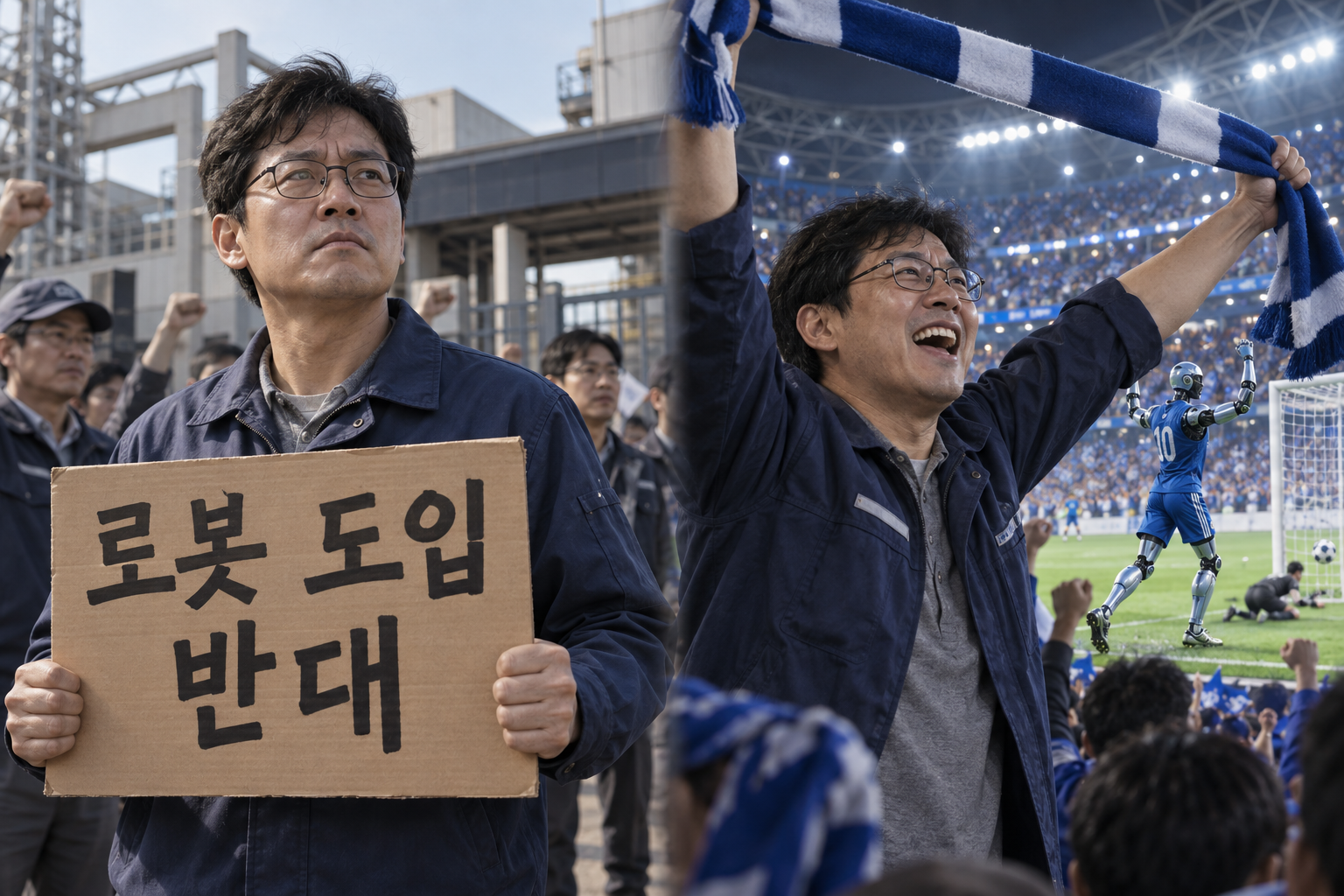
An AI-generated image imagining different moments in the day of a fan who opposes robot adoption yet cheers for robot football.
When imagining a new Luddite movement, I would want to consider these people's position too. Explaining resistance solely as a vague fear of robots would be inadequate. We would also need to examine changes in jobs, income, and the decision-making power of companies that owned the technology.
People supporting robot rights and people supporting human workers' rights would not necessarily have to stand on opposing sides. If a small group with control of technology determined both human working conditions and the conditions under which robots operated, they could share a concern about limiting that power. Conversely, we should consider the possibility that manufacturers might use affection for popular robots to shield their businesses from criticism.
I think sports could help robots become more familiar to people. But I do not expect enthusiasm to lead automatically to equal treatment. Spectators could respect a player during a match while ignoring the conditions of its existence outside the stadium.
Social acceptance of robot sports would depend on the industry's benefits and burdens for people as well as their feelings about robots. The same match could feel different depending on who profited from the robot team's success, who lost opportunities to work, and who made the rules.
How Much Power Could We Give Robots to Decide for Themselves?
These ideas naturally bring science fiction to mind. The Terminator makes me think first of war between humans and machines; Blade Runner, of the lives and treatment of created beings. Neuromancer and other cyberpunk works make me imagine societies in which body modification and corporate power have become part of everyday life. They are different works, but in this thought experiment they prompt me to ask what relationships humans will establish with the beings and technologies they create.
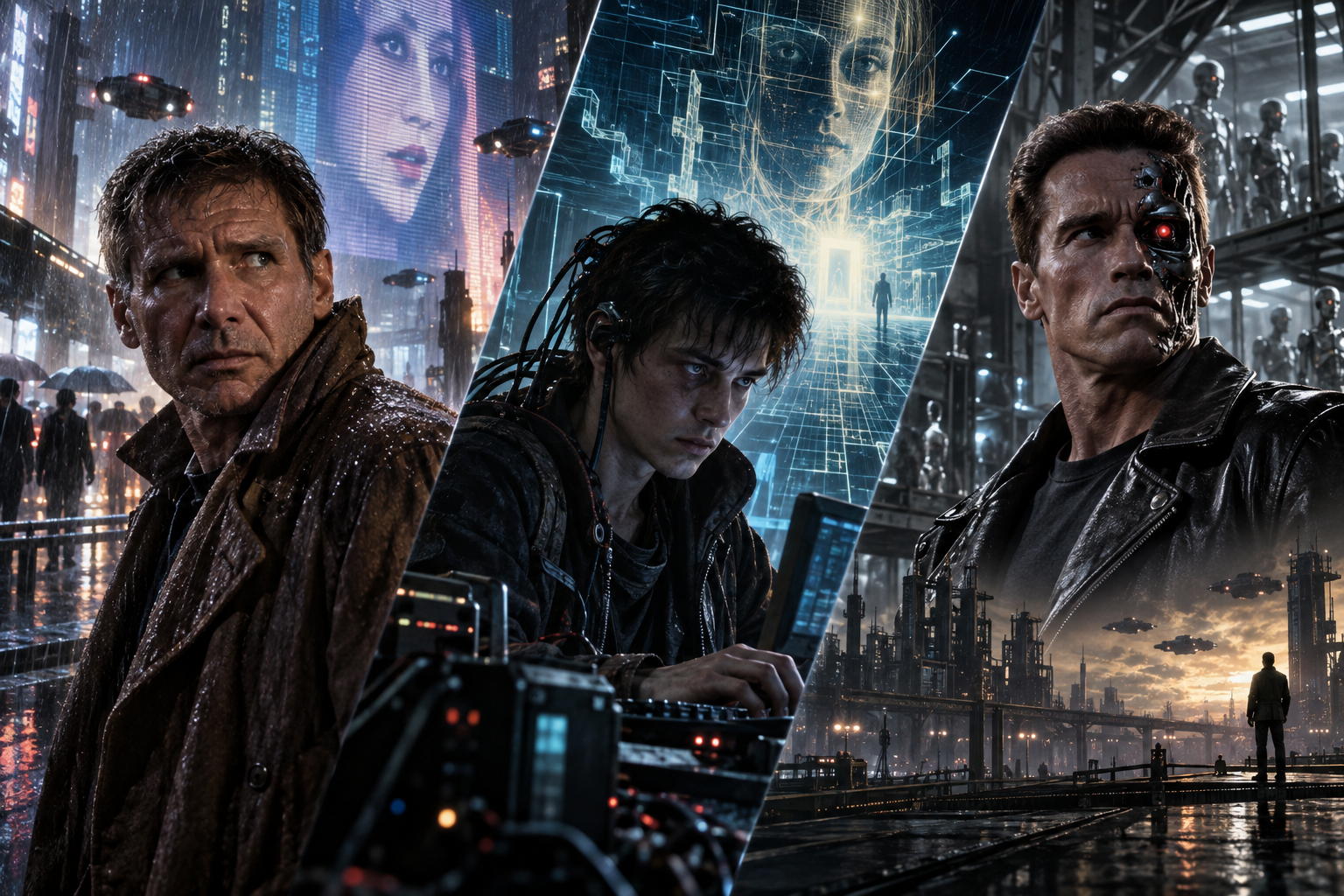
AI-generated fan art bringing together Deckard from Blade Runner, Case from Neuromancer, and the T-800 from The Terminator. This is neither an official film image nor an official crossover.
The Second Renaissance from The Animatrix, in particular, makes me worry about a future in which relations between robots and humans end in hostility and war. Still, I do not want to accept that story as the inevitable ending. Robots playing better than humans or earning more money would not, by themselves, make war unavoidable.
I would rather consider the smaller, concrete disputes that might arise first on the pitch. Who would authorize a player's move to another team? Whose consent would a club need to copy a player? What action could be taken against a robot that refused to play? Any discussion of the grounds and conditions for recognizing robots as independent agents would need to answer questions like these.
I think people could become enthusiastic about excellent robot performances. That affection could lead to demands that robots be respected. At the same time, people trying to protect their livelihoods and social standing might resist. Technology's performance alone would not determine which feeling became stronger.
I want to understand the arrival of a new era of debate as meaning that these questions will become harder to leave entirely in the realm of imagination. We cannot yet conclude that every robot should immediately receive the same rights as humans. But improving performance and growing revenue would not be enough to determine our relationships with them either.
It is easy to imagine applauding a winning robot. If that robot said it would not play next season, would its choice still be respected? I began by asking who would own the prize money and ended up wondering who would be allowed to make that decision.