Samsung's Dividend and the Middle Class in an Age of Robot Labor
Samsung's dividend raises a question: who receives the gains from automation? I consider robot taxes, a state-led basic income, and the risks facing a middle class built on wages, using examples from Korea and abroad.
When I saw the news about Samsung Electronics' dividend, another question came to mind before the amount per share: if robots and AI take on more work, whose income will their output become?
Samsung Electronics announced plans to pay about 30 trillion won in cash dividends in the third quarter of this year, including its regular dividend. The record date is September 30, and the board is expected to finalize the specific amount in late October. Rather than calculate a dividend that has not yet been finalized, I am interested in how the money a company earns reaches people through two different channels: wages and dividends. These details come from Samsung Electronics' shareholder return announcement and its dividend record-date notice.
This dividend follows Samsung Electronics' business results and shareholder return policy. It does not mean the company is distributing profits specifically generated by automation. Still, the news makes me think about what we will own, and how we will earn an income, in a future where robots do more of the production.
People Who Receive Dividends and People Who Receive Wages
When a company grows, employees receive wages and bonuses, while shareholders receive dividends according to their holdings. An employee can also be a shareholder. But wages come through a job, while dividends come through ownership of capital. As robots replace a wider range of human tasks, the relative importance of these two sources of income could change.

AI-generated image: Wages and dividends have different conditions for receiving them.
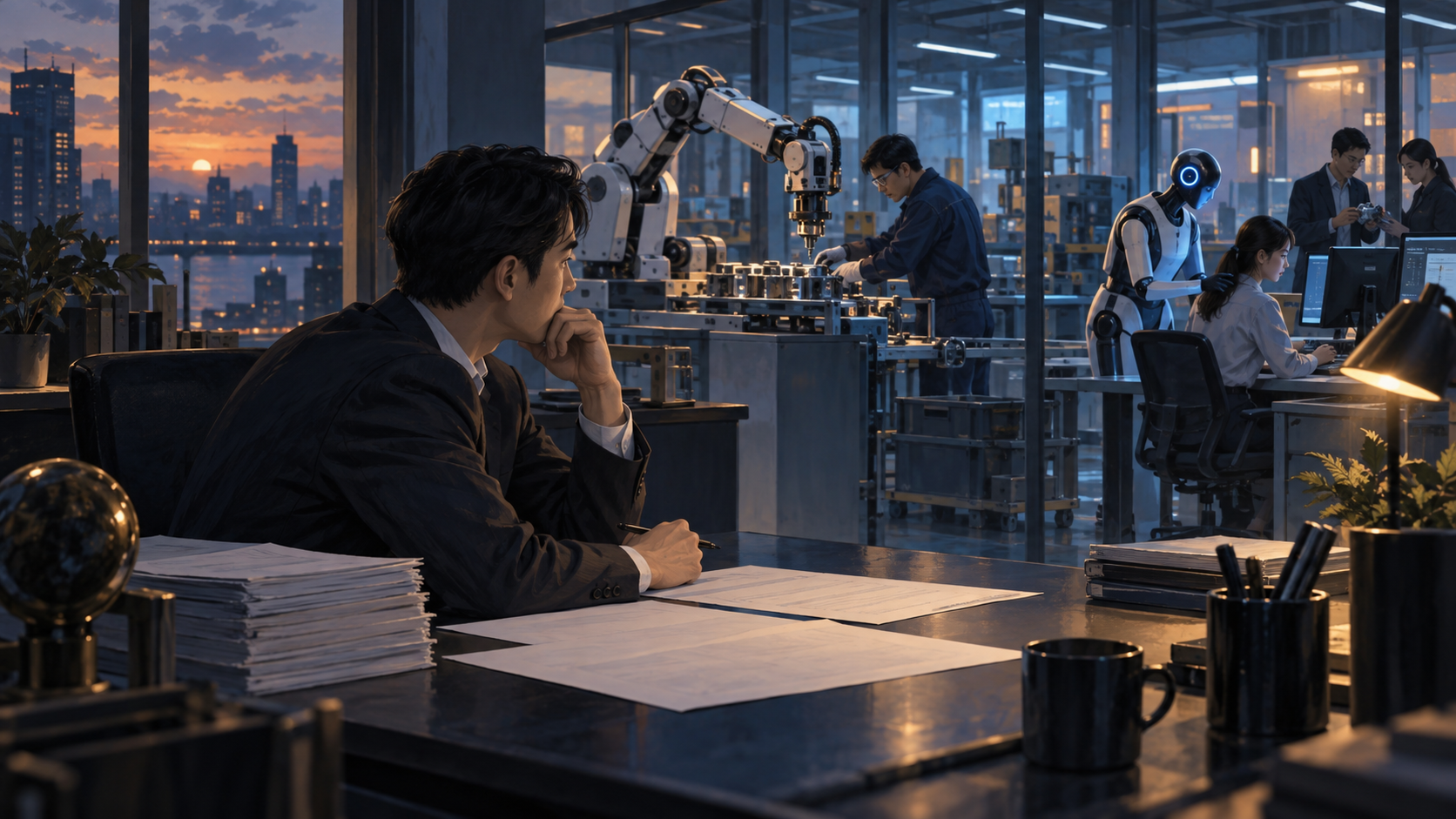
What worries me is a situation in which a company's revenue and profits grow, but hiring and wages fail to keep pace. Middle-class people who own shares would also receive dividends, but a small dividend is unlikely to make up fully for a reduced salary or a lost job. Even when the same company grows, people will experience the results differently according to how much capital they own.
The Middle Class's Path to Prosperity May Be the First to Weaken
There is no basis for saying that mass unemployment has already arrived. According to an OECD study of South Korea published in 2025, 56.5% of firms that adopted AI said it had replaced some tasks within existing jobs, but 95.5% said their department or team's headcount had not changed. What we can observe now looks more like changes in the content of jobs than the wholesale disappearance of jobs.

AI-generated image: The transition burden on a middle class that has relied on salaries and promotions to advance.
That does not mean we can relax. A KDI study of South Korea's labor market does not find a significant reduction in overall employment from AI adoption, but it does observe signs of reduced employment and income opportunities for young people. If AI handles the tasks once given to workers early in their careers, a company can hire fewer people without immediately laying off existing employees. A few years later, there may be fewer people who have had the chance to grow into skilled workers.
I think this shift could hit people who entered the middle class through the traditional route especially hard: studying, finding a stable job, and saving wages to buy a home and prepare for retirement. They have housing and education costs to pay each month, and changing jobs requires time to learn new skills. While wages and promotion opportunities shrink, they may not qualify for existing welfare programs. Their jobs might remain, even as the path that once raised their standard of living grows weaker.
Korea and Other Countries Are Already Testing Ways to Share Income
The US state of Alaska invests revenue from mineral resources and pays part of the investment returns to eligible residents each year. According to the Alaska state government's explanation, the program shares returns from local resources with residents. It does not distribute income generated by robots, but it shows one way to return the gains from a productive asset to members of a community.

AI-generated image: A symbolic depiction of Alaska's resource-revenue dividend.
In 2017 and 2018, Finland ran a basic-income experiment that paid 2,000 unemployed people 560 euros a month without conditions. In the Finnish government's evaluation, the employment effect was small, while recipients reported greater economic security and mental well-being. This was not a permanent basic income for the entire country. It shows both that cash payments can help reduce insecurity and that they do not solve employment problems on their own.
South Korea also operates Gyeonggi Province's Youth Basic Income and a rural basic-income pilot. The former is for young people who meet age and residency requirements. The latter gives residents of 17 selected counties local gift certificates worth 150,000 won a month. Neither is a nationwide basic income funded by a robot tax. They matter because they give policymakers practical experience in designing and running income support outside employment.
Would a Robot Tax Be Charged on Each Robot?
I expect to hear the term "robot tax" more often. In practice, however, a tax might look very different from a fixed charge per machine. It is difficult to separate work done by software from work done with human assistance for tax purposes, and indiscriminately penalizing investment in equipment could also reduce productivity. An IMF analysis of fiscal policy proposes considering taxes on capital income, adjustments to corporate taxation, and stronger unemployment insurance and retraining rather than a separate AI or robot tax.
AI-generated image: A robot tax is difficult to design even at the stage of defining what should be taxed.
To me, the central question is not how many robots there are, but who receives the gains created by automation. If the returns from using less labor accrue only to shareholders while social insurance continues to rely on wages for funding, the safety net could weaken as jobs decline. We need a more stable source of funding from corporate profits and capital income, with some of the proceeds returned to citizens in common. That would be closer to a rule for sharing the gains from technology than a tax intended to stop it.
I Believe an Era of State-Led Basic Income Is Coming
If AI and general-purpose robots keep taking over production and office tasks at lower cost than people, widespread unemployment or underemployment could follow. If change on that scale becomes reality, I believe the state will have to provide everyone with a basic income floor. Companies need consumers who can afford their goods and services, and citizens need income to buy time to adapt to technological change. This is my forecast about the future, not a claim based on unemployment figures already observed.

AI-generated image: Basic income should be designed alongside housing, healthcare, and retraining support.
That basic income should not simply abolish existing welfare programs and distribute the same amount to everyone. An OECD analysis of basic income points out that meaningful universal payments require substantial funding and that simply replacing existing benefits could leave poor households worse off. We should establish a shared minimum income while keeping housing and healthcare support, unemployment insurance, and retraining.
Basic income alone would probably not prevent the middle class from slipping downward. It can set a floor under living standards, but it cannot replace the route by which people built assets from their wages. That is why I think the state should consider both collecting some of the gains from automation through taxation and holding stakes in growing industries through a public fund. The returns could finance citizen dividends or help people build assets over the long term. I am describing a possible future design, not a policy that is already in place.
Ultimately, the issue is bigger than whether people should receive money when they are not working. The more important question is what right citizens have to share in wealth created by robots and AI. Today's dividends go to people who own shares. In the future, we will need to change the rules of income and ownership so that more people can share in the gains from productivity. The longer we delay that design, the more likely it is that the middle class, whose lives have grown through wages, will bear the cost of change first.